
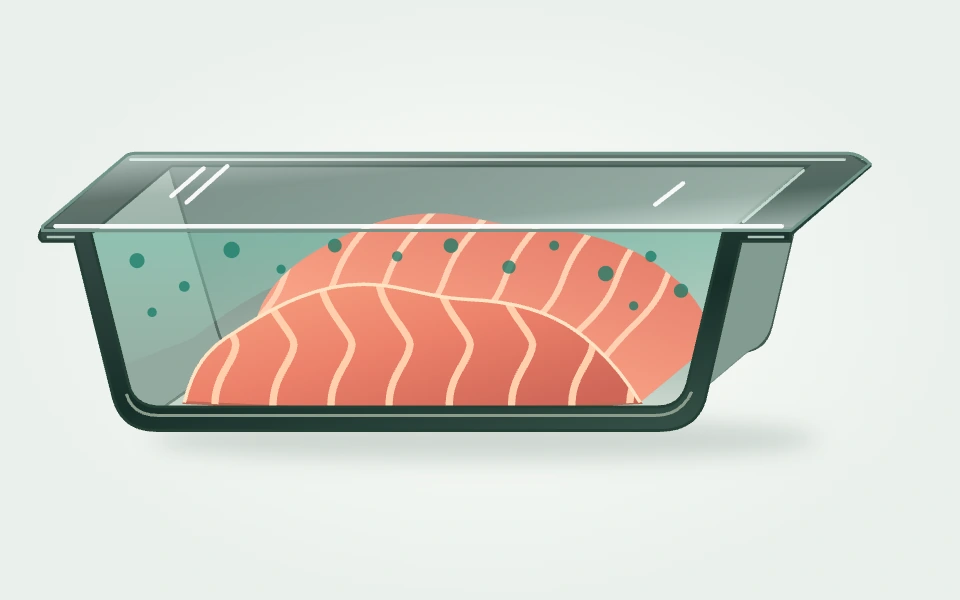
What happens in the chamber?
- Load and position the trays. Filled trays sit in pockets shaped for their base and rim. An operator loads the M-450 tooling by hand. On the T680, servo drives position trays at the sealing station.
- Remove the air. The chamber closes around the trays and the machine draws air out. The clearance between the food and the lid is called the headspace.
- Introduce the selected blend. The machine admits the gas specified for the product into the evacuated chamber. Record the gas specification with the tray and film details when requesting a configuration.
- Seal the lid and release the pack. The tooling presses the lidding film against the tray rim to form the heat seal. Once the chamber opens, the finished pack can leave the station. Check the seal around the full perimeter, including corners.
How do you check gas replacement?
In T680 tests with a single gas or a two-gas blend, residual oxygen in the pack measured below 0.5%. When the recipe calls for oxygen, nitrogen and carbon dioxide, oxygen is part of the fill. For that three-gas blend, the T680 specifications give a gas replacement rate of at least 99%.
Which tray and film details matter?
Measure the filled pack as well as the empty tray. A tall piece can touch the lid even when the outside tray dimensions fit the machine. Juice, sauce or a piece of food on the rim can interrupt the seal.
- Tray and portion
- Give the outside rim dimensions, depth, rim width and maximum filled height. For a cup, give the rim diameter and show how the cup sits in its carrier.
- Sealing surfaces
- Identify the tray material and the layer that contacts the film, including any coating on a paper-based tray. Ask the film supplier which sealing surface the lidding film is designed for.
- Film roll and layout
- Give the film specification, web width and roll diameter. The supplier can check how many trays of that size fit across the proposed tool and where the lid is cut.
In the pomegranate demonstration, filled round cups sit in circular pockets before sealing. That view shows why the rim needs support all the way around.
How many finished packs does a cycle produce?
One cycle is one complete machine sequence. One tool can seal several trays together. Ask for the number of filled trays per cycle for your tray drawing and the cycle rate for your selected process.
Worked example
Suppose a line completes 5 cycles per minute and seals 2 trays per cycle. It produces 10 packs per minute while cycling. These figures illustrate the calculation for a hypothetical tool.
For a shift estimate, multiply the running pack rate by the minutes available for production. Allow for pauses to load trays, replenish film, change tools and clean. Ask the supplier to confirm the expected rate with your food, tray, film and settings.
Match the machine to the way you load
M-450. An operator loads the trays, then removes them by hand after the M-450 completes chamber evacuation, gas filling and sealing. Its brochure lists a nominal 2–3 cycles per minute. Check tray fit and pockets per cycle for each format.
T680. For a line feeding trays automatically, the T680 positions the trays, runs the chamber cycle and discharges the sealed packs. The stated maximum in modified atmosphere packaging mode is 20 cycles per minute. Actual output depends on the pack and tooling.
DZML-450. Choose this model for continuous tray feeding. For its modified atmosphere packaging configuration, specify the tray, lidding film, gas blend and required throughput when requesting a quote.